What will it take to save the Fraser River Estuary
…and the 102 at-risk species that call it home?
T ara Martin grew up on the Salish Sea. She matter-of-factly calls the Fraser River Estuary its heart, no, make that its lifeline. The largest estuary on the Pacific Coast, and one of Canada’s most biodiverse ecosystems, it’s not just home to over 3 million residents and the county’s largest port, but also 102 species facing the risk of extinction.
“I lived overseas for 20-plus years and coming back, it was really obvious that nobody is really looking in their own backyard,” says Martin, a professor in conservation science at the University of British Columbia. “We have researchers studying coral reefs, and in the Arctic, and things far, far away—but there wasn’t a lot of work actually happening in in the estuary itself and certainly nothing trying to pull together all of the knowledge to date about the cumulative impacts to species and ecosystems in those areas.”
“Estuaries and water bodies, historically that is where we’ve settled as humans,” Martin continues. “We settle in these areas of rich resources, rich biodiversity and of course, now many of these areas are major cities and biodiversity is facing enormous problems. The story of the Fraser River Estuary, it’s the same story as the Saint John River, it’s the same story as the Bay Area in San Francisco.”
102 species risk extinction in the Fraser River Estuary
In 2017, MEOPAR funded Prioritizing Threat Management Strategies to Ensure Long-term Resilience of the Fraser River Estuary, a collaboration between Martin and the University of Victoria’s Julia Baum. Together, they wanted to go beyond studying threats in the area, and identify the actions needed to restore the estuary’s natural assets that were threatened thanks to issues like climate change, pollution and industrial and urban development. There was (and still is) no management plan in place for the 102 at-risk species in the area.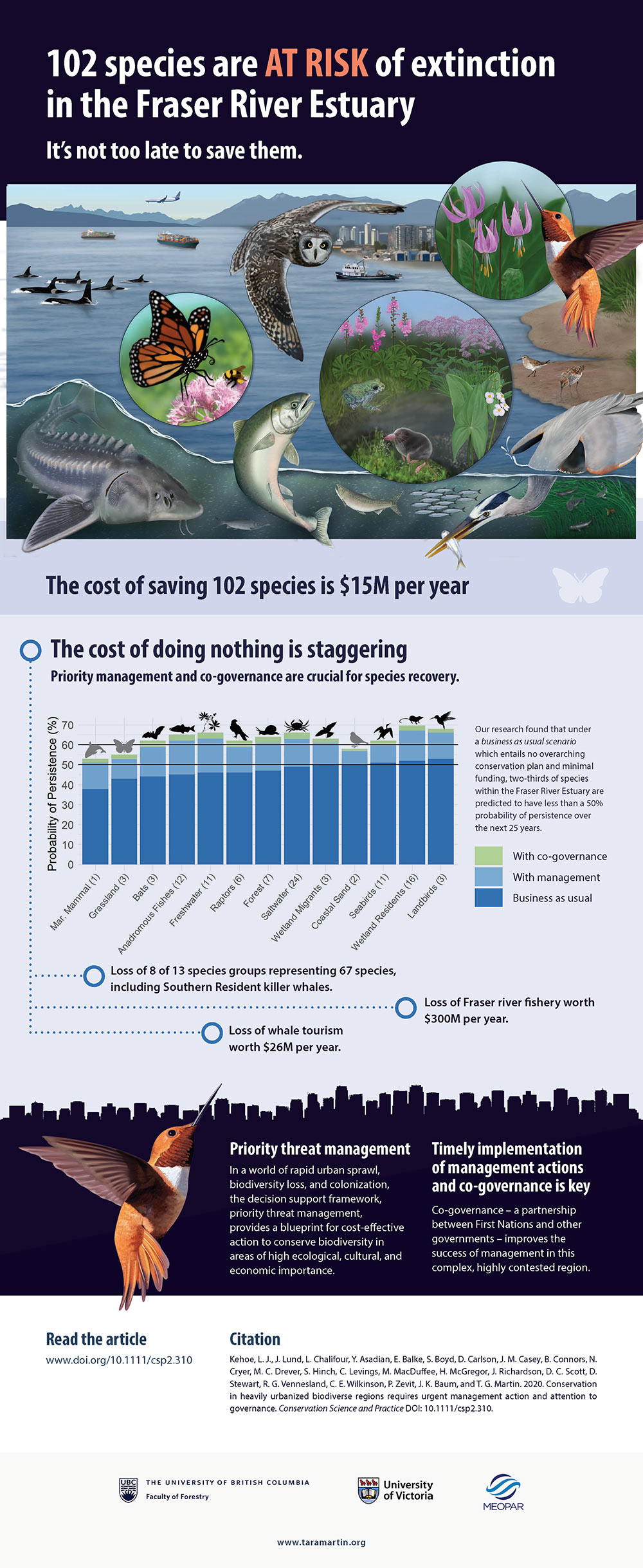
“Like most ecologists, I started out my career thinking if I just go and demonstrate the impact of logging, or the impact of fishing, or the impact of whatever, and publish a good paper on it, everything will change,” says Martin. “I realized that you need to marry the data on cumulative impacts with actions—costed actions on what to do about it.”
With this in mind, Martin’s team developed an approach called Priority Threat Management—a conservation decision-making tool that identifies the most cost-effective measures to conserve species. They brought together over 65 experts, spanning sectors and communities, to identify the cost, benefits and feasibility of various management strategies aimed at ensuring resilience in the Fraser River Estuary.Last week, the group published a paper in Conservation Science & Practice stemming from this research, citing that if action isn’t taken on the estuary, many of the at-risk species that call it home—from salmon to seabirds to killer whales— are likely to be extinct within 25 years.
But it’s not too late to do something about it.